SAXS for Biostructural Research
Developing drugs is a largely empirical process as biological systems are difficult to predict. Typically, large numbers of candidates are screened against defined properties followed by the development of structure-function relationships for the promising ones.
These relationships are used to support scientific knowledge in regulatory applications and to control quality throughout development and manufacture.


Challenges
Biological materials don’t sit still.
Proteins, lipids and nucleic acid systems are inherently unstable and exist in transient states that are hard to capture.
Non-native conditions produce less relevant data.
These materials are sensitive to pH, temperature and concentration. Data collected outside native conditions is often not reflective of real behaviour.
Function happens at the nanoscale.
Size, shape, oligomeric state, flexibility: the properties that control drug activity are invisible to low-resolution techniques.
Qualitative data can't drive decisions.
Without quantitative, high-resolution structural data, linking nanoscale properties to biological function remains largely guesswork.
Manual workflows don't scale.
High-throughput screening requires simple preparation and automated workflows whereas manual processes tend to be complex and hard to scale.
Why SAXS?
Small-Angle X-ray Scattering (SAXS) is uniquely capable of meeting this need, as samples can be prepared in the solution state at relevant concentrations, pH and temperature.
The SAXS data gives access to lipid organization in drug carriers, folding state of proteins, aggregation precursors and aggregation states and self-assembly pathways.
Using this knowledge, biomaterial scientists can select and develop drug candidates and optimise the formulation for stability, delivery and potency.
Information obtained
Lipid phase & nanostructure
The type of nanostructure (cubosome, hexasome, liposome etc) and its phase (lamellar, inverse hexagonal etc) control the stability of the particle, drug loading and release.
Protein folding & oligomeric state
The overall shape and folding state of a protein is related to its function and enables the formation of oligomers, which also impact function and manufacturing processes.
Aggregation precursors & aggregation states
Early detection of aggregation and insight into aggregation pathways that affect drug stability, efficacy, immunogenicity and shelf life.
Self-assembly pathways
Reveal the mechanism for spontaneous organization of supramolecules and large architectures important for biotherapeutic function and understanding disease mechanisms.
Size, shape & flexibility (Rg, Dmax)
The overall size, three-dimensional shape and flexibility of proteins reveals their biological function, molecular interactions and therapeutic performance.
Data example
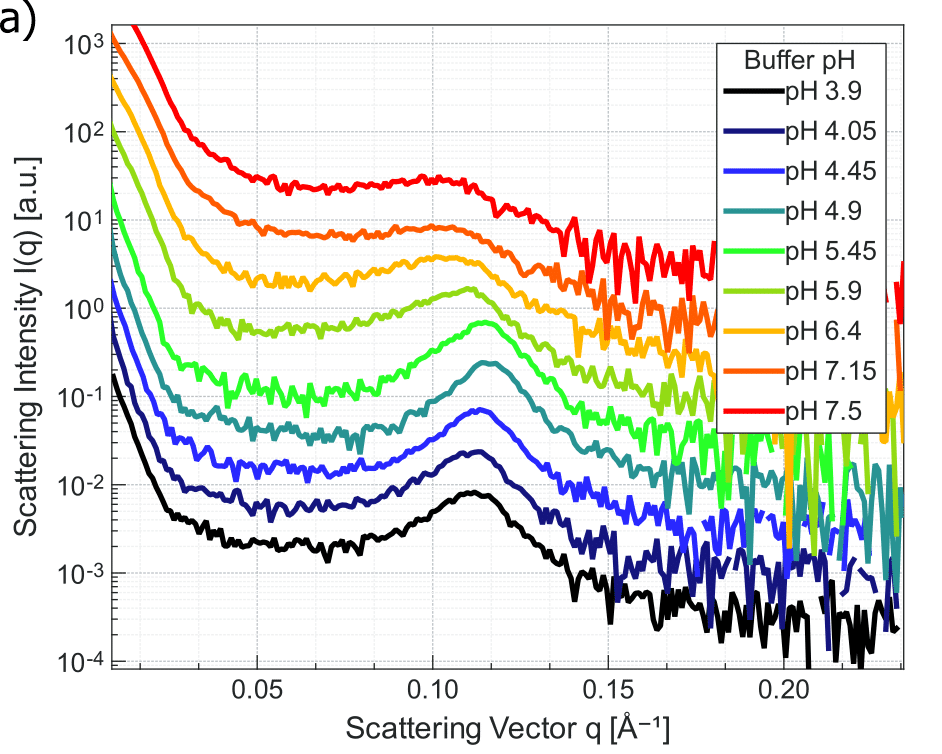
In this example, mRNA is loaded into a lipid nanoparticle formulation and analysed at different pH. The peak shifts are indicative of a structural change to the lipid assembly, which have been shown by other studies to be correlated to transfection efficiency of the mRNA payload [Wilhelmy 2025, Liu 2025].

Typical Product Configurations
Nano-inXider
Low budget


BioXolver
Mid budget


Xeuss Pro
High budget


Latest articles


