SAXS for Inorganic Materials
Inorganic materials science is being driven by demand for higher-performance, more sustainable, and multifunctional materials for applications including semiconductors, energy storage, catalysis, aerospace, construction, and advanced manufacturing. Researchers are increasingly designing materials with precise control over composition and microstructure to improve performance while reducing cost, energy consumption, and reliance on critical raw materials.


Challenges
Performance and stability pull in different directions.
Catalytic and porous materials need high surface area and mass transport to perform — but that porosity must stay stable under the high temperatures and pressures of industrial use.
Mechanical integrity is a balancing act, hard to predict.
Crack resistance, toughness, lightweighting, thermal stability, fatigue resistance: getting the microstructure right is difficult to predict under real-world conditions.
Function lives in atomic-scale defects, but stability is guesswork.
Electrical, magnetic, optical and ionic properties of films and functional materials trace back to surface and bulk crystal structure — yet how stable they stay under operating conditions is largely empirical.
Rheology and nanostructure are linked, but hard to predict.
Material flow depends on networks that form or deform under stress. Knowing when and why this happens is critical to performance, but composition and modelling alone can’t predict it.
Structure keeps changing, and function is hard to trace.
Different materials transform differently, often across multiple stages, making it hard to link structural shifts to real-world performance.
Solutions
SAXS/WAXS quantifies pore networks, aggregation states, crystallite size, interlayer distances, and hierarchical organization in powders, ceramics, films, and composites under realistic conditions. Grazing-incidence geometries probe surfaces while USAXS extends the size range, together capturing structural transitions and enabling the design, optimization, and quality control of inorganic systems by linking nanoscale architecture to macroscopic performance by measuring:
Particle and grain size distributions of catalysts
This relates to the available surface area to catalyze reactions and therefore impacts rate, but is also be used to control the quality of the manufacturing process.
Crystallite size and phase identification in catalysts, ceramics and oxide materials
Influences catalyst efficiency through controlling available reaction surface area, but also monitoring how this changes after processing steps including synthesis, calcination, sintering and heat treatment.
Porosity and pore size distribution of catalysts, ceramics and filtration membranes
This impacts the mass transport of solutes and gases by controlling diffusion rates through the material as a filtration mechanism or for chemical reaction at catalytic sites.
Interlayer spacing of clays, hydroxides and 2D materials
A key function of 2D materials is the rate of diffusion of ions, molecules and solvents in and out of the layers. Measuring the distance between and how this changes under different conditions controls this rate.
Filler dispersion and aggregation state of composites
Well dispersed fillers in the composite material improve mechanical properties including strength, stiffness and impact resistance, while aggregation creates weak points that reduce performance.
Rheology mechanisms of slurries
The particle-particle interactions and network formation and deformation are intrinsic to the flow behavior of slurries. Measuring these in-situ gives both insight to the mechanisms of flow and supports quality control.
Thin-film crystallinity of ceramics, oxides and functional films
Crystallinity influences electrical conductivity, dielectric behavior, optical properties, thermal conductivity, and catalytic activity. Using GISAXS and GIWAXS, the crystalline structure, domain size and distribution can be controlled.
Data example
In this example, anisotropy is found in smectite clays when under shear stress, as can be seen from the SAXS patterns collected at different rotational speeds using an integrated rheometer. The degree of anisotropy can be quantified in both the radial and tangential directions and shows that the particles aligned along the flow. This behaviour enables a shear thinning process whereby the suspension flows more readily under shear a valuable property for paints, coatings, cosmetics, drilling muds and concrete.
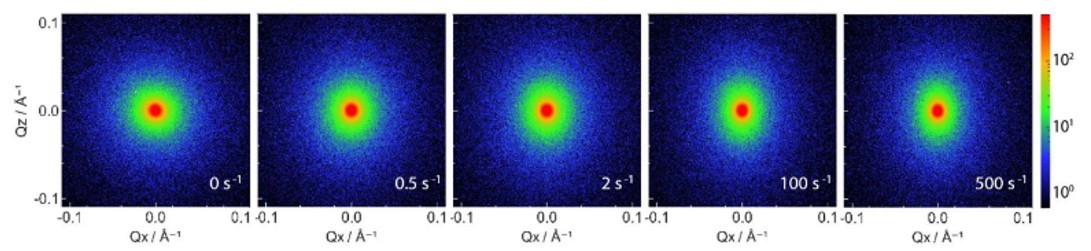
Figure 1. SAXS patterns recorded in the radial position on a 4.41 wt% concentration Na Smectite sample as a function of increasing shear rate (displayed in white in the images). The velocity (or flow) and vorticity direction are Qx and Qz respectively.

Typical Product Configurations
Nano-inXider
Low budget


Xeuss Pro
Mid budget


Xeuss Pro
High budget
Latest articles