What is measured?

Humidity-controlled SAXS/WAXS experiments provide quantitative access to:

  • Swelling or contraction of nanostructures, visible through shifts in SAXS peak positions
  • Changes in correlation lengths and packing distances
  • Hydration-driven phase transitions or ordering/disordering events
  • Crystallite deformation, captured by WAXS peak shifts in lattice spacings
  • Hydration and dehydration kinetics, using time-resolved measurement sequences
  • Hierarchical responses, where different structural levels evolve in distinct humidity ranges

Understanding these moisture-driven changes is essential for optimizing the performance, stability, and processing of humidity-responsive materials across a wide range of applications.
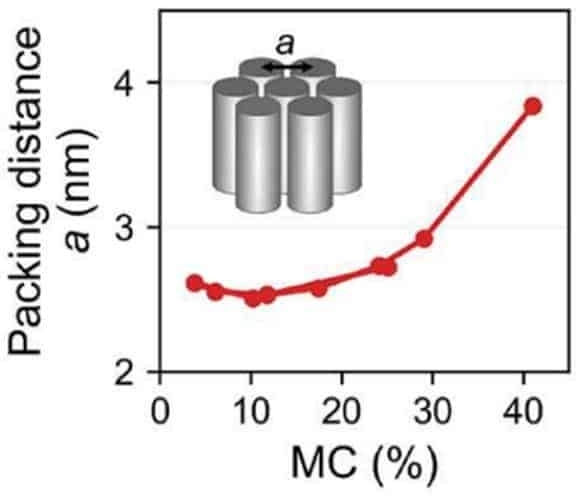
Figure 1. Microfibril packing distance in spruce wood as a function of moisture content as determined from SAXS data.

Samples

Humidity-controlled SAXS/WAXS analysis is suitable for:

  • Cellulose and wood-derived materials, where fibril spacing and crystallinity evolve with RH
  • Membranes, ionomers, and fuel-cell materials
  • Hydrogels, biopolymers, and soft water-responsive systems
  • Thin films and coatings, sensitive to water uptake
  • Nanocomposites and porous materials, where moisture modifies interfaces and porosity


Why use SAXS/WAXS for Humidity-Induced Structural Evolution analysis?

Humidity-controlled SAXS/WAXS offers a uniquely complete view of how water reshapes material structure, enabling improved formulations and reliable performance in real environments.

01

Direct sensitivity to moisture-driven structural evolution

Capturing how spacing, morphology, and nanoscale organization change with humidity.

02

Complementary insight across length scales

Linking mesoscale swelling or porosity changes (SAXS) with lattice-level deformation or rearrangement (WAXS).

03

Quantitative characterization of hydration behavior

Providing swelling curves, spacing evolution, correlation lengths, and structural descriptors as functions of relative humidity

04

Non-destructive analysis of hydrated or fragile materials

Allowing measurements on delicate, fully hydrated, opaque, or soft samples without altering their moisture state.

05

Capability for cyclic and kinetic studies

Supporting reversible–irreversible path analysis and real-time monitoring during repeated humidity cycles or dynamic hydration processes.