Small Angle X-ray Scattering (SAXS) is a powerful and versatile technique for the characterization of liposomes in solution. By probing structures at the nanometer scale under native conditions, SAXS provides access to critical information that is difficult or impossible to obtain with other methods.

Its value for liposome analysis is driven by the following key characteristics:

X-ray technique: SAXS is able to penetrate the outer surface and offers insights into the important internal structure of liposomes.
 
Non-intrusive: SAXS does not require special sample (pre)-processing or treatment such as filtering, heating, freezing or drying, and provides a true view of the structure and interactions in a natural environment.

High information content: Structural and interaction information. Apart from overall size, shape and internal structural parameters, biomolecular interactions, binding (e.g. proteins and ligands) and aggregation can also be studied.

Fast screening capability: Being a relatively fast and automated technique, SAXS can be used to monitor structural and stability changes under varying formulation conditions or temperature.

Technique complementarity: SAXS provides unique as well as orthogonal information to other common techniques. This makes SAXS a truly synergetic technique in combination with other features in fast obtainable techniques. For example, electron microscopy (EM) data can assist in interpretation of SAXS data and SAXS can validate EM data in solution and be used to easily track identified features under varying conditions.
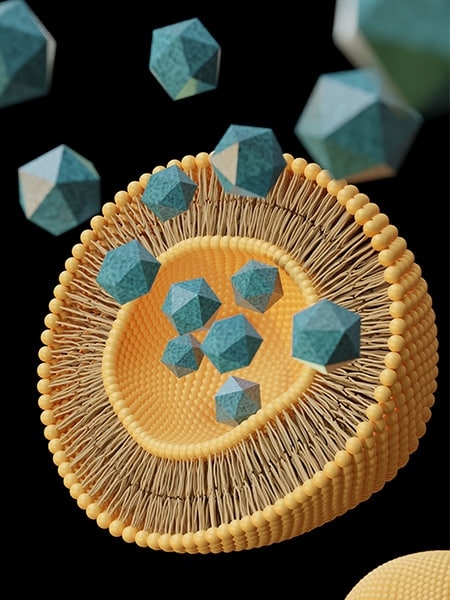
SAXS insights into liposome properties and formulations

Size and shape information

Functional properties and stability of formulations, interactions, encapsulation and release properties can all be impacted by the size and shape of a liposome.

  • SAXS determines the average size of liposomes.
  • SAXS reveals the overall shape of the liposome (spherical, elongated, etc.).


Self-assembly

The self-assembly can influence the encapsulation capacity and release kinetics of liposomes.

  • SAXS provides insights into the correlation of lipid bilayers present in the liposome structure (unilamellar, oligolamellar, or multilamellar…).

Membrane thickness

SAXS estimates the thickness of the lipid bilayer(s), which is important for understanding the stability and permeability of liposomes.

Internal structure

SAXS reveals information about the internal organization of liposomes, such as the presence of any internal compartments or the arrangement of encapsulated materials.

Interactions with other molecules

SAXS provides information on the interactions between liposomes and other molecules in a non-intrusive environment, such as with binding proteins or ligands.

Structural changes under varying conditions

  • SAXS can monitor structural changes in liposomes under different environmental conditions, such as temperature, pH, or ionic strength.
  • SAXS data from empty vs filled liposomes can be used to investigate the structural changes upon drug encapsulation.
  • This information significantly aids in the understanding of the stability and functionality of liposomes in different physiological environments.

Correlating interaction parameters and drug properties

Drug encapsulation and release

SAXS can provide insights into the interaction between liposomes and encapsulated drugs. By comparing the scattering profiles of empty liposomes and drug-loaded liposomes, one can investigate the structural changes in liposomes upon drug encapsulation. Additionally, SAXS can be used to study the release kinetics of drugs from liposomes under different conditions, such as temperature or pH variations.

Protein-liposome interactions

SAXS can be used to study the binding and interactions of proteins with liposomes, providing information on conformation and orientation of the protein within the lipid bilayer or at the liposome surface. This information can help understand how proteins interact with liposome-based drug delivery systems or how membrane proteins are embedded in lipid bilayers.

Liposome aging and aggregation

SAXS can be used to study the fusion and aggregation of liposomes, which are important processes in various biological and pharmaceutical applications. By analyzing the scattering profiles of liposome mixtures under different conditions, one can gain insights into the mechanisms of liposome aging and aggregation.

Environmental factors

SAXS can be employed to investigate how environmental factors, such as pH, temperature, ionic strength, or the presence of other solutes, affect liposome structure and stability. This information can be crucial for optimizing liposome formulations and understanding their behavior in physiological environments. Such liposomal understanding improves bioavailability and reduces potential side effects.

Liposome-liposome interactions

SAXS can be used to study the interactions between different liposome populations, including the formation of multi-lamellar structures or the phase behavior of liposomes with varying lipid compositions. This information can help understand the behavior of liposome mixtures and the factors influencing their stability.

Correlating structural parameters and drug properties


The internal structure and organization of liposomes can influence the encapsulation, release, and stability of the encapsulated drug. SAXS helps in the understanding of these structural features and can help elucidate how the liposome’s internal structure affects the drug’s properties:

01

Encapsulation efficiency

The size of the internal aqueous core and the organization of the lipid bilayer can impact the encapsulation efficiency of hydrophilic drugs, while the bilayer structure and lipid composition can influence the encapsulation of hydrophobic drugs.

02

Release kinetics

The bilayer thickness, lipid composition, and overall liposome size can affect the release kinetics of the encapsulated drug. A thicker bilayer or a more rigid liposome structure may result in slower drug release, while a more fluid or porous structure can lead to faster release. The rigidity and fluidity of the lipid bilayer and liposomes can depend on the type of lipids (saturated or unsaturated) or of temperature, pH, mechanical stress, etc., and can also be identified by SAXS.

03

Stability

The liposome’s internal structure, including lipid composition and bilayer organization, can influence its stability under various conditions, such as temperature, pH, and mechanical stress. A more stable liposome structure can protect the encapsulated drug from degradation and improve its shelf life.

Resources

Shear, pore size release: S. Karaz, & E. Senses, Liposomes under shear: structure, dynamics, and drug delivery applications, Advanced nanobiomed research, 3(4), (2023). DOI: 10.1002/anbr.202200101

Dissolution: N.F. Khan, M. Salim, S. Y. B. A. Bakar, K. Ristroph,R. K. Prud’homme, et al., Small-volume in vitro lipid digestion measurements for assessing drug dissolution in lipid-based formulations using SAXS, International Journal of Pharmaceutics, 4, (2022). DOi: 10.1016/j.ijpx.2022.100113

General SAXS/SANS Liposome study: D. Urimi, M. , Hellsing, N., Mahmoudi, C. Soderberg, R., Widenbring, et al., Structural characterization study of a lipid nanocapsule formulation intended for drug delivery applications using small-angle scattering techniques, Molecular pharmaceutics, 19(4), (2022). DOI: 10.1021/acs.molpharmaceut.1c00648.

Review: B. Sartori, & B. Marmiroli, Tailoring lipid-based drug delivery nanosystems by synchrotron small angle X-ray scattering, Pharmaceutics, 14(12), (2022) .DOI: 10.3390/pharmaceutics14122704.

Lysophilisation: B. Stark, G. Pabst & R. Prassl, Long-term stability of sterically stabilized liposomes by freezing and freeze-drying: Effects of cryoprotectants on structure, European journal of pharmaceutical sciences, 41(3-4), (2010). DOI: 10.1016/j.ejps.2010.08.010.

Protein/Peptide-liposome interactions: T. Narayanan, D. Weerakkody, A. G. Karabadzhak, M. Anderson, O. A. Andreev & Y. K. Reshetnyak, pHLIP peptide interaction with a membrane monitored by SAXS, The Journal of Physical Chemistry B, 120(44), (2016). DOI: 10.1021/acs.jpcb.6b06643.

Liposome-liposome interactions: K. Komorowski, A. Salditt, Y. Xu, H. Yavuz, M. Brennich, et al., Vesicle adhesion and fusion studied by small-angle X-ray scattering, Biophysical Journal, 114(8), (2018). DOI: 10.1016/j.bpj.2018.02.040.

Liposome characterization using SAXS & SANS: E. Di Cola, I. Grillo & S. Ristori, Small angle X-ray and neutron scattering: powerful tools for studying the structure of drug-loaded liposomes, Pharmaceutics, 8(2), (2016). DOI: 10.3390/pharmaceutics8020010.